The Emergence of Machine Storytellers
When AI Dungeon launched in 2019, it caught everyone off guard. Here was the first mainstream RPG powered entirely by artificial intelligence, and it was nothing like the text adventures we’d grown up with. No predetermined paths. No multiple choice menus. Just you, typing whatever wild idea popped into your head, and an AI dungeon master that somehow rolled with it.
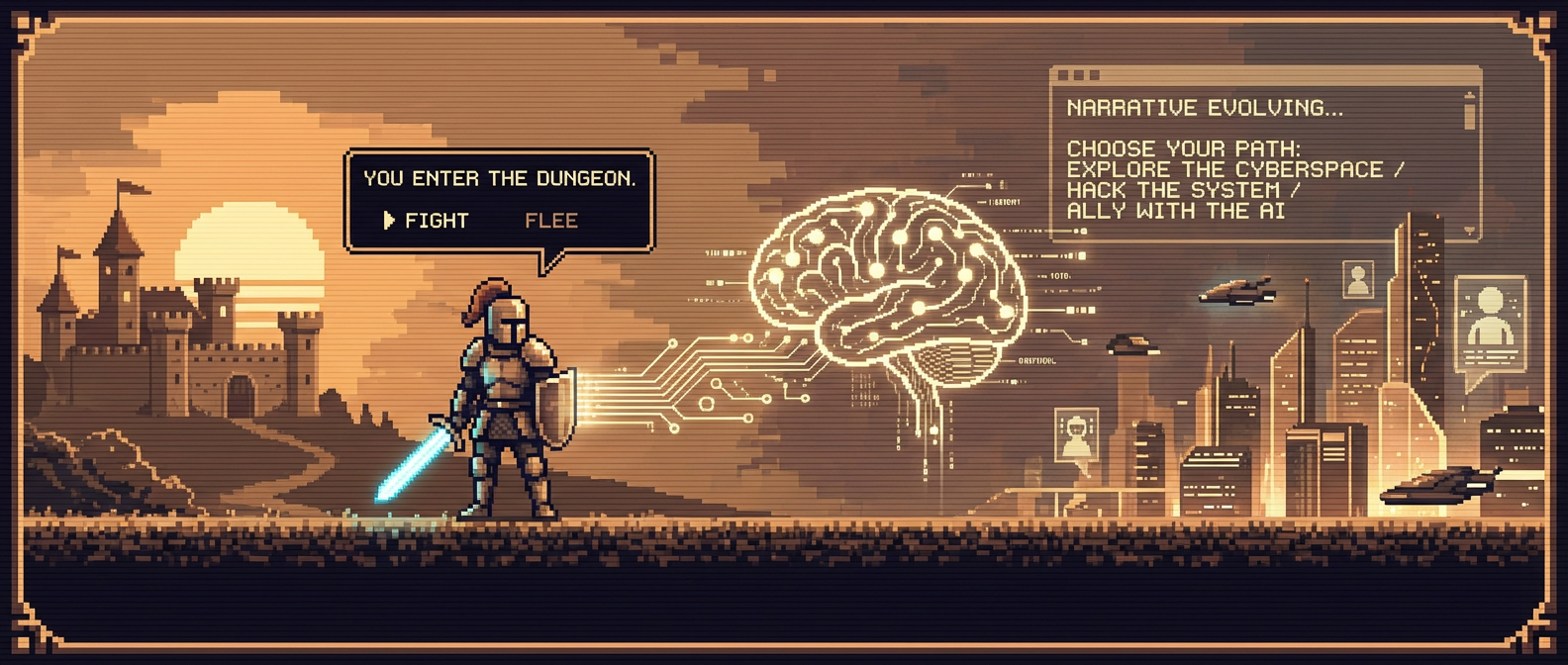
Within months of launching on GPT-2, AI Dungeon hit two million users. People were hungry for this kind of freedom. You could type “I want to seduce the dragon” or “I attempt to negotiate a peace treaty with the goblins using interpretive dance,” and the AI would actually try to make it work. Sometimes brilliantly, sometimes hilariously, but it always tried.
What really struck me was how this exposed the limitations we’d accepted in traditional RPGs. Even the best games can only anticipate so many player choices. Developers build amazing worlds, but they’re still bounded by what someone thought you might want to do. AI-driven games threw those boundaries out the window. Suddenly the only real limit was whether you could explain your idea clearly enough for the AI to understand it.
Alternative Platforms and Community-Driven Solutions
AI Dungeon proved the concept worked, but it also showed the problems. Server issues, content filters, subscription costs. That’s when things got interesting. KoboldAI emerged for folks who wanted to run their own models locally. No cloud dependency, no content restrictions, complete control over your experience. The trade-off? You needed decent hardware and some technical know-how.
NovelAI creative writing went the premium route, offering better models and fewer restrictions than the mainstream options. They found their audience among users who wanted more mature content or just didn’t want someone else deciding what stories they could tell. It’s a smart approach – different platforms for different comfort levels and needs.
Then Character.AI surprised everyone by taking a completely different direction. Instead of traditional adventures, they focused on character conversations. Twenty million daily users, many of them doing roleplay with AI versions of fictional characters or historical figures. It turns out people wanted to chat with Sherlock Holmes or argue philosophy with Socrates just as much as they wanted to fight dragons.
Transforming Tabletop Gaming Experiences
Here’s where AI roleplay gets really practical for regular gamers. Solo play used to mean wrestling with random tables and solo adventure modules that felt like homework. Now you can have actual conversations with an AI that remembers your character, tracks your campaign, and responds to whatever crazy plan you devise.
The scheduling problem alone makes this worthwhile. I can’t count how many campaigns I’ve seen die because someone moved, had a baby, or just couldn’t make Tuesday nights anymore. An AI doesn’t cancel sessions or show up unprepared. You can pick up your character’s story at 2 AM on a Saturday if that’s when inspiration hits.
Even experienced DMs are finding ways to use AI as a creative partner. Need quick NPC dialogue? The AI can handle it. Want detailed descriptions of that tavern you didn’t plan for? AI’s got you covered. It’s not about replacing human creativity but augmenting it. You keep the big picture control while the AI fills in details and responds to player curveballs you didn’t see coming.
Redefining Interactive Narrative Formats
Traditional interactive fiction works like a tree. Every branch has been planned, every outcome written in advance. The author anticipated your choices and crafted responses accordingly. It’s elegant, but it’s also fundamentally limited by human foresight and time constraints.
AI roleplay throws out the tree structure entirely. Instead of following predetermined branches, you’re having a real-time conversation where the story emerges from the interaction itself. Neither you nor the AI knows exactly where things are heading. The narrative becomes a collaborative improvisation session.
This creates possibilities that traditional interactive fiction simply can’t match. You can develop relationships with characters that evolve organically over multiple sessions. You can pursue plot threads that no human author ever imagined. The story adapts not just to your major choices but to your personality, your quirks, your specific way of approaching problems. It’s less like reading a book and more like participating in an ongoing creative partnership.
Practical Considerations for Modern Players
Let’s be honest about what AI roleplay does well and where it struggles. These systems excel at generating creative responses and maintaining conversational flow. They’re terrible at remembering what happened three hours ago or keeping track of complex logical relationships. Working with AI means accepting that you’ll need to help maintain story consistency.
The best AI roleplay sessions happen when you treat the technology as a creative partner, not a replacement for human game masters. This means providing context when important details matter, gently correcting course when the AI loses track of something crucial, and embracing the weird tangents that only machine creativity can produce.
Platform choice really matters depending on what you want. Cloud services are convenient and powerful but come with content restrictions and connectivity requirements. Local solutions give you complete freedom but require technical setup and hardware that can handle language models. Neither approach is objectively better, they just serve different needs.
AI roleplay isn’t going to replace your weekly D&D session or make traditional games obsolete. But it opens up new possibilities that didn’t exist before. Solo adventures that actually respond to your creativity. Experimental storylines too weird for predetermined narratives. Character interactions that develop over time in unexpected directions. The technology keeps improving, but the core appeal remains the same: stories that adapt and respond to your unique creative vision in real time.